Plush toy making procedures
In Funivamart’s toy development process, sample design and pattern making are crucial foundations for product finalization. We firmly believe that an excellent fabric toy should not only be cute and proportionally harmonious but also possess good production feasibility and safety. Therefore, before creating patterns, Funivamart first determines the actual dimensions of the sample based on the design sketches and then determines the drawing scale accordingly. Simultaneously, we also rationally plan the proportional relationships between the various parts of the physical sample based on its size.
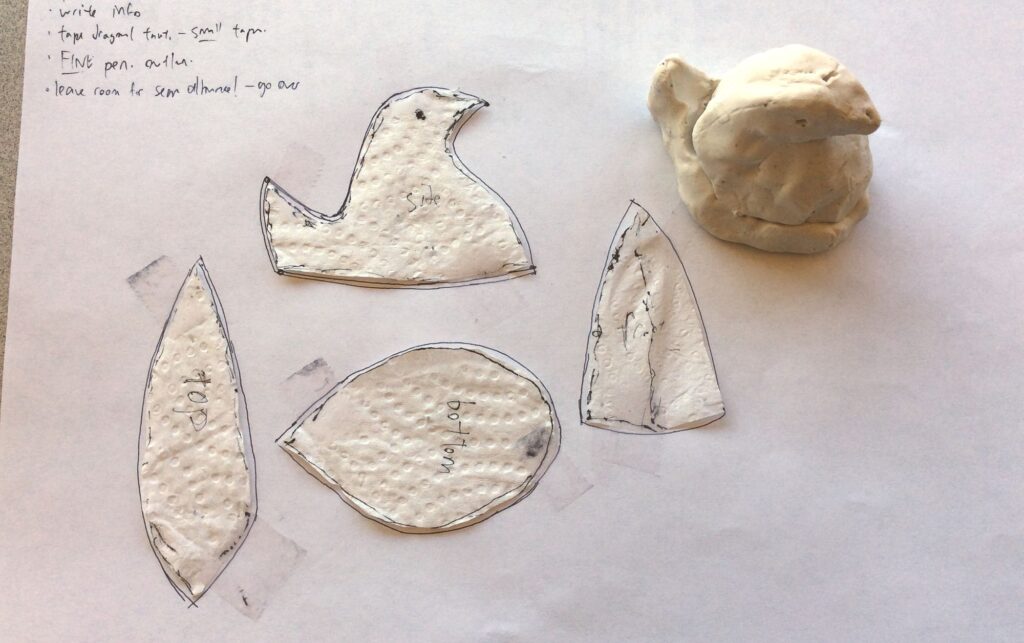
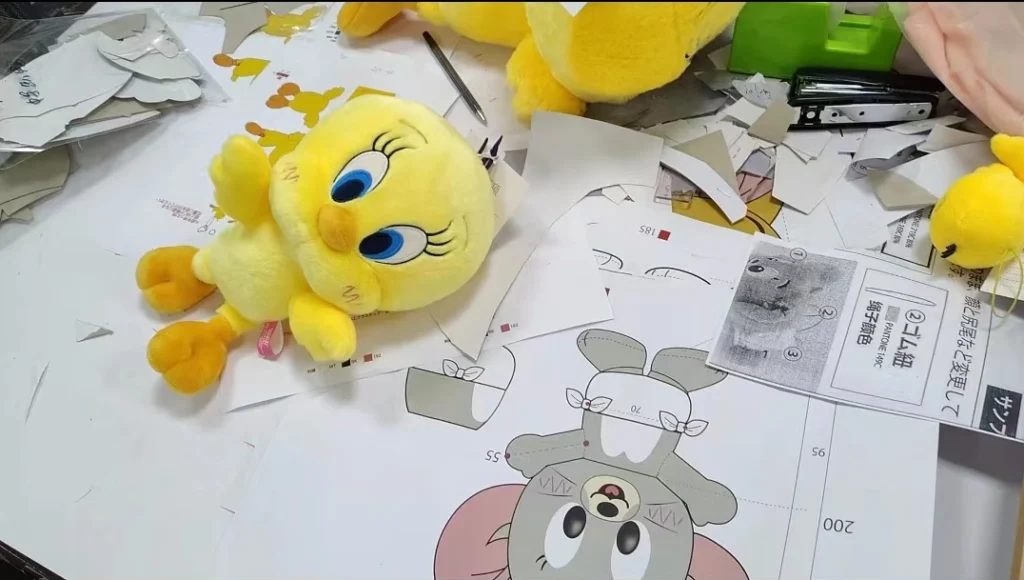
Toy pattern making typically begins with the overall shape and then gradually breaks it down into different patterns such as the head, body, limbs, and accessories. When developing samples, Funivamart prioritizes determining the large structural patterns and then extends other detailed patterns based on the overall shape. This approach not only facilitates maintaining the overall proportions of the toy but also allows for subsequent adjustments and modifications, ensuring the final sample closely resembles the design.
The Relationship Between Toy Patterns and Three-Dimensional Space
Fabric toy pattern making is the process of transforming a two-dimensional design into a three-dimensional form. This requires designers to possess strong spatial imagination. The size, orientation, curvature, transitions, and shape of the pattern directly affect the fullness and three-dimensionality of the final product.
In Funivamart’s sample development, we place particular emphasis on the roundness and visual appeal of the toy’s overall silhouette. For example, the head of a typical plush toy should have a rounded and full effect from the front, with naturally puffed cheeks; the side profile should also maintain a soft and smooth curve; the corners of the mouth can be slightly upturned, and the forehead broad and smooth, creating a cute, childlike appearance.
These seemingly simple pattern designs actually undergo meticulous structural analysis and proportional refinement. Designers need to consider three-dimensional space, rationally combining different parts such as the head, body, and legs, so that the flat pattern, after sewing and filling, can present a natural, vivid, and stable three-dimensional form. For more complex realistic toys, Funivamart also employs more refined segmentation methods to ensure that the product possesses both aesthetic appeal and meets actual production needs.
The Impact of Toy Design on Pattern Making
Toy patterns are typically structurally broken down from multiple angles, including the front, side, and bottom. Excellent toy design drawings help pattern makers more accurately determine proportions and structure, reducing the number of repeated trials and improving development efficiency.
Funivamart places great emphasis on the connection between design drawings and pattern making in product design. We don’t simply pursue complex shapes in the pattern itself, but rather focus on whether the pattern accurately reproduces the proportions in the design drawings. Because the proportions in the toy drawings are reasonable, the proportions in the pattern are more likely to be stable, and the final product is more likely to achieve the expected results.
For some larger structural components, designers can directly refer to the shape relationships in the design drawings for pattern development. This not only saves time but also reduces material waste. Therefore, Funivamart encourages the design team to continuously improve their drawing skills, modeling abilities, and structural understanding, creating a more efficient collaboration between design drawings, patterns, and physical samples.
The Relationship Between Toy Patterns and Mass Production
For Funivamart, mature patterns must not only make the toy image cute and vivid but also facilitate mass production in the factory. Overly complex pattern designs increase the difficulty of cutting, sewing, assembling, and finishing, and also raise production costs. Therefore, when designing patterns, we comprehensively consider appearance, production efficiency, material utilization, and process stability.
A mature toy sample should possess characteristics such as reasonable proportions, clear shape, simple pattern, and stable structure. Such samples are more conducive to production layout, batch cutting, and standardized sewing, and also help factories reduce unnecessary manual processes, improve production efficiency, and reduce material waste and manufacturing costs.
During the sample development process, Funivamart repeatedly checks whether the pattern is suitable for actual production, including details such as fabric direction, seam allowance, curve treatment, splicing positions, and stuffing effects. We hope that every pattern entering the production stage can balance aesthetics and operability.
The Relationship Between Toy Patterns and Product Safety
Safety is a crucial aspect of Funivamart’s toy development process. Pattern safety is reflected not only in the main structure but also in the way accessories are assembled. Especially for infant and toddler toys, the safety risks during child use must be fully considered when designing accessories such as belts, scarves, bags, buttons, clips, and tire straps.
When creating patterns, designers cannot only pursue aesthetic appeal but must also ensure that accessories fit tightly with the toy body, avoiding excessive gaps to prevent children’s fingers from getting stuck, pulling, or accidentally disassembling the toy. Since children easily tear toys during play, if the pattern does not adequately consider the fabric’s grain direction, stress points, and the physical characteristics of curved openings, the fabric may be stretched, torn, or even the filling may be exposed, creating safety hazards.
Therefore, Funivamart continuously optimizes stress-prone areas in its pattern design, such as openings, curved seams, angled areas, and accessory connections. By rationally adjusting the pattern structure and sewing methods, we make our products more robust, safe, and durable.
Funivamart’s Toy Pattern Making Philosophy
Strictly speaking, toy pattern making is a professional task that integrates observation, analysis, segmentation, calculation, and development. Whether the design is simple or complex, Funivamart follows a scientific development process: first, observe the overall shape; then analyze the structural relationships; next, make reasonable divisions; and finally, complete the final pattern through dimensional calculations and repeated trials.
Toy pattern development is like performing geometric calculations. Only by understanding the principles of design and mastering structural rules can a design be smoothly transformed from a two-dimensional plane into a three-dimensional object. The real challenge lies in whether the designer can create a complete three-dimensional spatial image in their mind and determine which parts are suitable for division, splicing, scaling, and adjustment.
Funivamart consistently adheres to professional design as its foundation, safe production as its standard, and cute, practical, and stable product effects as its goal. We hope that through a rigorous pattern development process, each design sketch will be transformed into a high-quality fabric toy sample that is proportionally harmonious, vividly depicted, suitable for production, and meets safety requirements.