
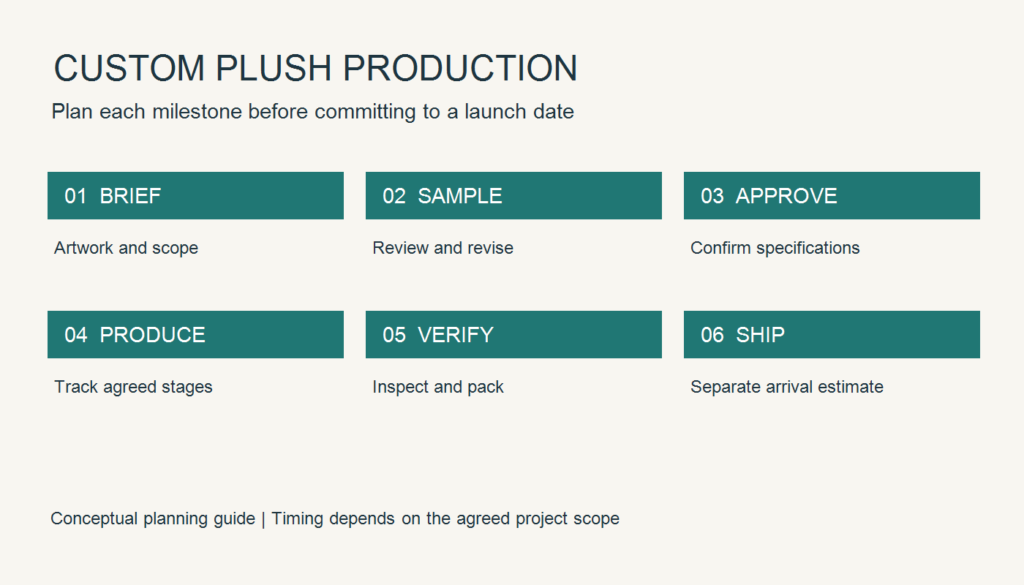
Start with a project schedule, not a single delivery promise
Custom plush toy production takes a sequence of decisions and manufacturing steps. The useful answer is a schedule that separates design preparation, sampling, approvals, material purchasing, bulk production, inspection and transport. A factory’s production estimate may cover only part of that journey. Before announcing a launch date, ask exactly where the quoted lead time starts and where it ends.
This guide explains how to build that schedule and identify the information needed for a project-specific estimate. It does not promise a fixed Funivamart turnaround. Designs, quantities, materials, approval rounds and delivery arrangements differ, so confirm the dates and assumptions in writing for your order.
1. Define what your deadline actually means
“Ready in October” could mean finished at the factory, handed to a carrier, cleared through customs or available in your warehouse. Those are different milestones. Start with the date when you need usable stock at the destination, then work backwards through receiving, transport, inspection and manufacturing. Include any preparation your own team needs before the products can go on sale.
For an event or seasonal release, distinguish a preferred arrival date from a date after which the goods lose their purpose. Tell the supplier which one applies. Ask for a realistic schedule before committing to promotional activity. A production completion date should not be presented internally as a guaranteed arrival date.
2. Make the design brief complete enough to quote
A clear brief reduces the number of unresolved questions that move into sampling. Provide front, side and back artwork where available, target dimensions, intended shape, colors, fabric preferences and decorative details. Identify accessories, labels, packaging and any functions that affect construction. Explain which features are essential and which can be adjusted if they create manufacturing difficulties.
Include the intended audience and destination markets so the relevant product requirements can be considered by qualified parties. Avoid leaving important decisions until the sample arrives. A change from embroidered eyes to a different component, for example, may affect the construction and the subsequent review process.
Our custom plush toy design process guide explains how an idea becomes a reviewable sample. Use the brief as a version-controlled document: record the agreed version and date rather than relying on scattered chat messages.
3. Separate sample creation from sample approval
The time needed to make a sample is only one part of the sampling stage. Your team must review it, consolidate comments and decide whether another version is necessary. If a physical sample is sent to you, courier transit and your availability also affect the calendar. Ask whether the initial estimate includes that shipment and any revision rounds.
Review the sample against a checklist covering appearance, dimensions, fabric, color, decoration, accessories and packaging. Photographs can support discussion, but they do not replace every physical assessment. Decide which details require a physical review and who has authority to approve them. Sending contradictory feedback from several reviewers can create additional cycles.
Group comments into one clearly numbered revision list. Describe the desired outcome and reference the affected part of the sample. After changes, check the revised version against both the new comments and the previously accepted details. Keep the approval record with the final specification so everyone works from the same reference.
4. Confirm when the bulk-production clock starts
A quoted bulk lead time may depend on several conditions being satisfied first. These can include sample approval, the final order quantity, agreed commercial arrangements, artwork approval and availability of the required materials. Ask the supplier to list the conditions that apply to your order instead of assuming the clock begins when you first request a quotation.
Record a production-release milestone with an owner and a date. Confirm whether any specifications remain open at that point. If a packaging file or label is still awaiting approval, ask whether it affects the full order or a later operation. This makes a delay visible early, when there may still be a practical way to resolve it.
5. Check material availability and custom components
Fabric, filling, thread, labels and accessories need to match the approved specification. Availability can differ between a small sample and a bulk quantity. Ask which materials are already available and which need purchasing or custom preparation. A substitute should be reviewed for its effect on appearance, construction and applicable requirements before it is accepted.
Color matching and specially made accessories deserve explicit milestones. Request confirmation of the approved material reference and how changes will be handled. Do not assume that a material shown during early discussions has been reserved for your order. If your schedule depends on a particular supply arrangement, have that dependency written into the project plan.
6. Understand the scope of bulk manufacturing
Bulk production can involve cutting, decoration, sewing, filling, finishing and packing. Different designs place different demands on those operations. A simple silhouette with limited decoration should not be used as a timing comparison for a complex character with many small parts. Ask the supplier to explain the main scheduling constraints for your specific design.
Quantity matters, but it is not the only variable. The number of designs, sizes and color variants affects preparation and coordination. When comparing order options, ask how each option changes the proposed schedule. Our minimum order quantity guide explains related questions to raise before selecting an order configuration.
Agree how progress will be reported and which milestones are meaningful. “In production” is too broad to tell you whether an order is on schedule. A dated update identifying the completed stage, remaining work and any unresolved issue provides a more useful basis for planning.
7. Reserve time for inspection and corrective work
Inspection should be part of the schedule from the start. Agree what will be checked, who performs the review and what evidence is needed before release. The approved sample and written specification should provide a consistent reference. If independent testing or inspection is part of the project, coordinate its scope and timing with the appropriate provider.
A plan that leaves no time to address a finding is fragile. Ask how nonconforming items will be handled and how successful corrective work will be verified. Avoid assuming that every issue can be solved by packing the shipment faster. Some findings require a decision, replacement material or repeat work, so escalation responsibilities should be clear.
8. Treat packaging and shipping as separate workstreams
Packaging artwork, barcode information, carton markings and destination instructions can hold up an otherwise finished order. Approve these items alongside the product wherever practical. Check whether your warehouse or sales channel has its own labeling and delivery instructions, and provide the applicable version before packing begins.
Ask a logistics provider for the transport estimate that matches the actual route and service. Clarify the shipment handover point, documents, customs responsibilities and final delivery arrangements. Transit estimates and manufacturing estimates come from different parts of the process; neither should silently stand in for the other. Keep a contingency appropriate to the project rather than presenting every estimated date as certain.
A practical schedule to request with your quotation
- Brief confirmed: agreed artwork, dimensions, materials, variants and packaging requirements.
- Sample ready for review: stated scope, review method and delivery arrangements.
- Final approval: named decision-maker, approved version and unresolved items closed.
- Production released: all agreed prerequisites satisfied and material status confirmed.
- Inspection and packing: review dates, corrective-work process and shipping documents.
- Dispatch and arrival: separate estimates with clear responsibility for each stage.
Add a column for the person responsible and another for evidence of completion. Review the plan whenever the specification, quantity or delivery arrangement changes. A short written change record helps the buyer and supplier understand whether the original dates still apply.
How to shorten the process without hiding risk
The most useful improvements often happen before manufacturing. Provide complete artwork, consolidate feedback, assign one approval owner and answer questions promptly. Discuss simpler construction or available materials when those options still meet your design goals. Confirm the effect of a change before treating it as a time saving.
If the deadline is fixed, ask which parts of the plan can realistically change. Options such as fewer variants or a different delivery arrangement need their own cost and operational review. Compare the complete proposal, including any extra handling, rather than accepting an accelerated date with unclear assumptions. The custom plush toy cost guide provides a framework for discussing the budget alongside the schedule.
Frequently asked questions
Can I get an exact production time before sampling?
You can request a preliminary estimate, but ask which assumptions remain unconfirmed. A schedule based on an approved design, final quantity and known materials is more useful than a date attached to an incomplete brief.
Does a repeat order automatically take less time?
A repeat order may need fewer design decisions, but availability, capacity and changes to specifications still need confirmation. Provide the previous approved reference and identify every change before requesting the new schedule.
Should shipping be included in the production lead time?
List it separately even when one supplier coordinates both. This makes the factory completion date, dispatch date and destination arrival estimate clear and reduces misunderstandings about what has been promised.
What should I send Funivamart to request a schedule?
Send your artwork, dimensions, quantity by variant, preferred materials, decoration, packaging, intended market and delivery destination. State the required arrival date and ask for a schedule covering approvals, production, inspection and transport assumptions.