
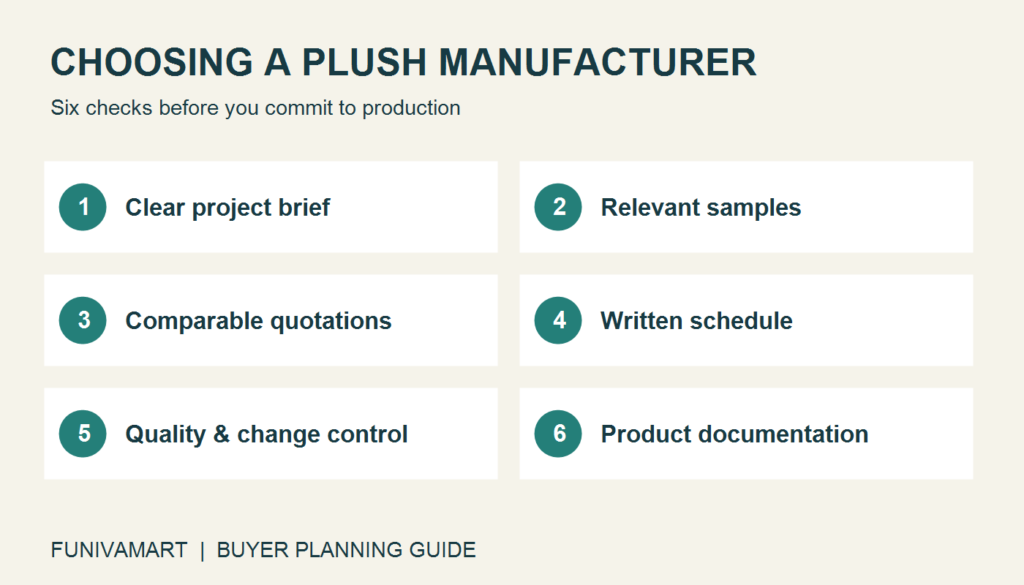
Choosing a custom plush toy manufacturer in China starts with a clear product brief and a way to compare evidence. A low quotation or an attractive sample photograph cannot tell you whether a supplier can reproduce your character, control material changes, communicate revisions, and deliver an order that matches your approved requirements.
This guide focuses on supplier selection: what to ask for, how to compare responses, and which decisions to settle before committing to production. It does not rank factories or promise a universal price, minimum quantity, or delivery time. Those details depend on your design, specifications, order size, and the supplier’s current capacity.
1. Define your project before requesting quotations
Give every shortlisted supplier the same written brief. Include front, side, and back artwork where available, the intended finished size, quantity per design, preferred fabric appearance, decoration method, packaging concept, and delivery destination. Explain which visual features are essential and which can be adapted during sampling.
State who will use the product and where it will be sold. A retail toy, a promotional mascot, and a collectible display item may require different design reviews and documentation. Do not assume a supplier can determine your entire compliance plan from a character drawing. Assign that review to the appropriate people before approving materials or accessories.
For a first inquiry, a concise specification sheet is more useful than a large collection of inconsistent references. Number each version and identify the current one. If you are still exploring the concept, distinguish open questions from fixed requirements so the quotation does not silently turn assumptions into commitments.
2. Confirm who will actually make the product
Ask the supplier to explain its role in the project. Will it develop the pattern, make the sample, purchase materials, sew the units, finish the decoration, and pack the order itself? Which operations, if any, will be handled by another business? A clear answer helps you understand responsibility and communication routes.
Request the legal business name and the name that will appear on quotations, invoices, and payment instructions. Resolve differences before placing an order. A trading company and a factory can each provide useful services, but you should understand whom you are contracting with and who manages production problems.
When practical, arrange a factory visit, a live walkthrough, or an independent assessment suited to the size of the project. Ask to see relevant operations rather than relying only on a showroom. Treat photographs and videos as supporting information; they do not by themselves establish current capacity or ownership.
3. Look for experience relevant to your design
A supplier’s broad product catalogue is less useful than evidence that it understands your construction challenges. Show the difficult parts of your character: narrow limbs, a large head, asymmetrical details, a distinctive facial expression, or a combination of fabrics. Ask how those features would be translated into a sewn product.
Request examples that demonstrate comparable construction, without asking the supplier to disclose another customer’s confidential artwork. Look at seam placement, embroidery alignment, proportions, and how the toy holds its intended shape. A photograph of a different product is a conversation starter, not proof that your design is already solved.
Notice whether the supplier explains tradeoffs. For example, a very small embroidered detail may need simplification, and a printed texture may behave differently from a textured fabric. Useful technical feedback connects a proposed adjustment to appearance, construction, or repeatability instead of simply promising that everything is possible.
4. Evaluate the sampling process
Ask what the sample fee includes, how revisions are handled, and what you receive at each approval stage. Clarify whether the sample uses intended production materials or temporary substitutes. A substitute can help explore shape, but it should be labelled so you do not mistake it for a final material approval.
Review the physical sample against your brief. Photographs can hide differences in scale, softness, filling distribution, and finish. Prepare one consolidated revision list with annotated images and priorities. Separating essential corrections from optional refinements helps both teams understand when the sample is ready.
Keep a dated approval record and an agreed reference sample. Record dimensions, materials, decoration, labels, and packaging alongside that reference. Our custom plush toy design and sampling guide explains the development stages that lead to a usable sample approval.
5. Compare quotations on the same basis
A meaningful comparison needs more than a unit price. Ask each supplier to identify the quantity, size, fabric, filling, decoration, accessories, packaging, and delivery terms used in its quotation. Mark any item that is excluded or still provisional. Otherwise, two prices may describe different products.
Separate development charges from repeat production costs. Confirm the treatment of sample fees, packaging setup, testing, inspection, and transport where these apply. Ask how a change in order quantity or specification would affect the quotation, and how long the quoted terms remain valid.
Compare total project cost alongside the risks created by unresolved assumptions. A cheaper option may still be appropriate, but you should know whether savings come from a simpler construction, a different material, or an omitted service. See the custom plush toy cost guide for the main inputs to discuss.
6. Check quantity and scheduling assumptions
Ask whether minimum quantities apply to the whole order, each character, each colour, or each material. A mixed collection can create different purchasing and production needs from a single design. Request a written explanation of how your proposed assortment affects the order, rather than assuming one headline minimum covers every variation.
For timing, separate sample development, revisions, material purchasing, production, inspection, packing, and transport. Ask which event starts each stage and which decisions are required from you. A production estimate should not be treated as the date the goods will arrive at your warehouse.
Build your launch plan around confirmed dependencies. For a more detailed planning framework, read how long custom plush toy production takes. Do not substitute a general online timetable for the supplier’s written schedule for your actual order.
7. Agree on quality checks and change control
Ask how the supplier checks incoming materials, work in progress, and finished goods. Discuss the defects that matter for your product, such as incorrect facial placement, inconsistent proportions, loose stitching, incorrect labels, or packaging errors. Turn subjective expectations into reference photographs and written acceptance points wherever possible.
Establish what happens if an approved material becomes unavailable. Require a documented proposal and your approval before substitutions are used. The same principle applies to decoration, accessories, and packaging. A change that appears minor to one person can alter your product’s look or affect the review it needs.
Define inspection arrangements before the order reaches its final stage. Agree who reports findings, who decides on corrective work, and what evidence confirms the work is complete. Inspection reduces uncertainty but does not replace a clear specification, a suitable testing plan, or the buyer’s own responsibilities.
8. Review documentation without accepting blanket claims
Ask what documentation is available for the proposed product and materials. If the supplier shares a test report, check the product identification, materials, dates, issuing organisation, and scope with a qualified reviewer. A report for another item should not be treated as evidence that your new design has passed the same review.
Describe your intended market and use accurately, and confirm the applicable requirements with appropriate specialists. Avoid selecting a supplier solely because its website displays familiar certification logos. The useful question is what evidence relates to your specific order and how any missing evidence will be obtained before shipment.
9. Test communication before placing the order
The quotation and sampling stages reveal how a supplier manages information. Look for clear answers, identified assumptions, versioned drawings, and prompt explanations when a request needs investigation. Speed alone is not the measure: a short reply that leaves important questions unanswered may create more work later.
Agree on a main contact, an escalation route, and the format for progress updates. Keep approvals in a shared written record rather than scattered across informal messages. Ask who covers the project when the main contact is unavailable, especially around critical sample and shipment decisions.
A practical shortlist checklist
- The supplier has received the same current brief as every other candidate.
- The contracting business and production responsibilities are clear.
- Relevant construction experience has been discussed using evidence.
- Sample fees, revisions, materials, and approval records are defined.
- Quotations identify inclusions, exclusions, quantities, and delivery terms.
- The schedule separates development, production, inspection, and transport.
- Substitutions and quality issues require an agreed decision process.
- Product-specific documentation needs have an owner and a plan.
Use these points to document your decision, not to create a score that hides unanswered questions. Before choosing, identify the most important unresolved issue for each candidate and obtain a concrete response. A smaller, well-understood shortlist is easier to manage than a long list of incomparable quotations.
Frequently asked questions
Should I choose the lowest quoted price?
Only after confirming that the quotations cover the same specification and services. Compare the approved construction, material assumptions, packaging, quality arrangements, and delivery terms. A price difference is useful information when you understand what causes it.
Can I select a manufacturer using sample photographs alone?
Photographs help shortlist suppliers, but a physical sample provides information about shape, feel, scale, and workmanship that pictures may miss. Use a sample and written specification together when deciding whether to proceed.
What should I send in my first inquiry?
Send artwork, intended size, quantity per design, target market, packaging needs, destination, and your preferred schedule. Identify uncertain details and ask the supplier to list its assumptions so you can compare responses fairly.
When should I approve bulk production?
Approve it after the agreed sample, specification, quotation, schedule, and required review arrangements are settled. Keep a written approval record and require further approval for changes. Unresolved details are easier to address before materials and production are committed.
To discuss a project with Funivamart, prepare the same brief you would use for your shortlist and ask for a proposal based on your actual requirements. Clear information gives both sides a better basis for evaluating fit.