
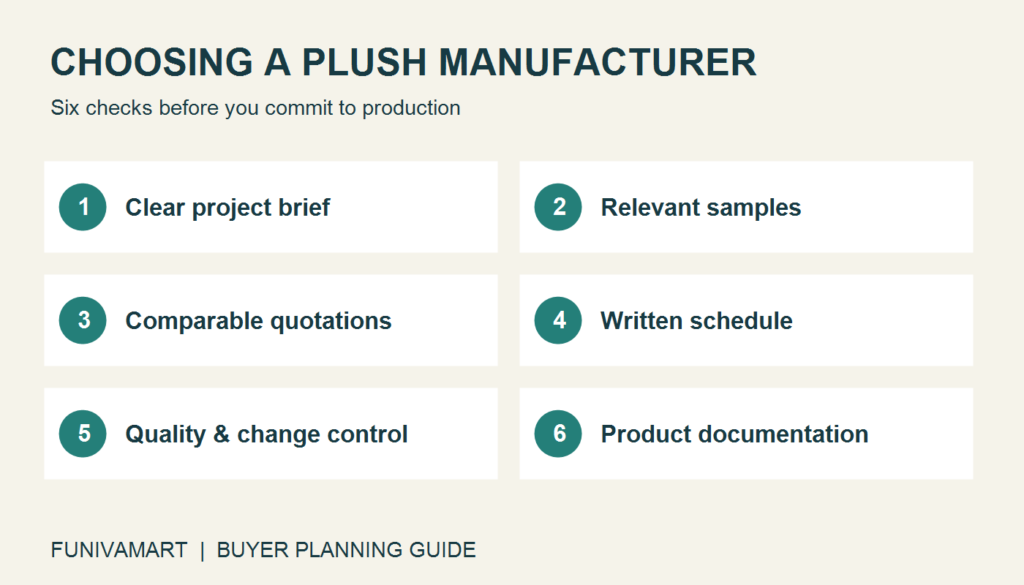
A useful conversation with a plush toy factory should produce more than a unit price. Before placing an order, you need a shared definition of the product, the approval process, the delivery scope and the evidence required before shipment. Otherwise, two apparently similar quotations may describe very different projects.
This guide turns that conversation into a practical question list. Use it when preparing a first enquiry, reviewing a sample or confirming a repeat order. The questions are purchasing prompts, not promises about any particular supplier’s capacity, pricing or delivery time. Record the answers against a dated version of your design brief.
1. What information do you need to quote this exact design?
Ask the factory to identify missing information before treating its price as final. A drawing alone may not define the finished height, body proportions, fabric texture, filling feel or decoration method. Include front, side and back views where possible, plus an explanation of which details are essential to the character.
State the intended audience, destination market, estimated quantity and packaging concept. If dimensions refer to a seated toy, say so; a measurement including ears or accessories can produce a different interpretation. Ask the supplier to list its assumptions in the quotation. An explicit assumption can be corrected early, while an unspoken assumption may only become visible in the first sample.
2. Which work will you perform, and which work needs another supplier?
Clarify responsibility for pattern development, sewing, embroidery, printing, accessories, labels and packaging. Some projects involve more than one production partner. The important question is who coordinates those steps and who takes responsibility when a component does not match the agreed specification.
Ask who will be your main contact and whether technical questions can reach the person reviewing the design. Request relevant process evidence for comparable construction challenges, such as a narrow embroidered face or a removable garment. A general product catalogue is less useful than an explanation of how your specific design will be made. For the broader division of design responsibilities, see our OEM versus ODM plush toy guide.
3. How is the minimum order quantity calculated?
Ask whether the minimum applies per design, colour, size or total order. A collection of several characters may not count as one production run, even when the overall quantity looks substantial. Custom fabric colours, printed packaging and special accessories may also have separate purchasing minimums.
Request a written explanation of what changes when you order less or more. Does the unit price change, does the packaging change, or does a different material become necessary? Avoid comparing a standard-material quotation with a custom-material quotation as though the scope were identical. Our custom plush toy MOQ guide explains the questions behind an order minimum.
4. What exactly is included in the sample fee?
Ask whether the fee covers pattern development, the first physical sample, materials, decoration and shipping. Clarify how many revision rounds are included, what counts as a revision, and what happens if the concept changes substantially. Request written conditions for any credit or refund offered against a later order.
Agree on a feedback method before sampling begins. A single annotated document with numbered changes is easier to follow than scattered messages from several reviewers. Identify who on your team can approve the sample. Keep a record of unresolved points so that a promising appearance does not accidentally become approval of every construction detail.
5. Which materials and decorations will be locked after approval?
Ask for a material list that identifies the outer fabric, filling, embroidery thread, printed areas, accessories and labels at a practical level of detail. Colour names such as cream or sky blue are not precise enough on their own. Discuss physical swatches or another agreed reference and how colour variation will be assessed.
Also ask what happens if a selected material becomes unavailable. A substitute can affect appearance, feel, production steps and the documentation associated with the product. Require proposed substitutions to be reviewed before use. If sustainability is part of your brief, ask what evidence supports the specific material claim instead of relying on broad words such as green or eco-friendly.
6. What will the approved production reference include?
A photograph is useful for communication, but it does not fully capture fabric feel, stuffing firmness or construction. Ask whether both parties will retain matching approved samples and a written specification. Record the sample version, date, dimensions, decoration placement and any agreed tolerances.
Separate appearance approval from approval of packaging, labels and other requirements. If the sample uses a temporary accessory or substitute fabric, mark that exception clearly. Before bulk production, request confirmation that the final reference incorporates the changes you approved. This prevents an earlier sample from becoming the working reference simply because it was the easiest one to find.
7. What starts the production clock?
A lead time is meaningful only when its starting point and exclusions are clear. Ask whether the clock starts after payment, final sample approval, artwork approval or arrival of a particular material. Separate development, material purchasing, production, inspection and transport instead of treating them as one unexplained number.
Discuss your required arrival date, not only a factory completion date. Ask which decisions you must make by which dates, and how a late approval affects the schedule. Request updates at agreed milestones and an early warning if a dependency changes. Our plush production timeline guide provides a framework for planning those stages.
8. How will you check quality against our specification?
Ask where checks occur during production and what the final inspection will compare against. Useful topics include shape consistency, seam finish, decoration alignment, filling distribution, label placement and packing accuracy. The checklist should reflect your actual product rather than a generic statement that quality is important.
Discuss how defects are classified, how inspection results are documented and what happens when goods fail the agreed criteria. If you plan to use an independent inspector, establish access, timing and the information they need before production finishes. Ask who approves rework and whether a second inspection is required. A clear correction process is more useful than an undefined assurance of perfect quality.
9. What documentation is needed for this product and market?
Give the supplier the intended destination and audience, then ask what product information it needs to support a review of applicable requirements. Keep this discussion specific to the design, materials, accessories and intended use. Do not assume that a document for a different toy automatically covers your order.
Where reports or certificates are offered, ask for the complete document and check the product identity, scope and date with the appropriate qualified party. Agree who arranges any required testing, who pays and how a design or material change will be handled. This article is a purchasing checklist; it does not determine the legal requirements for a particular toy or market.
10. What will arrive in each carton?
Confirm individual packaging, quantities per carton, assortment rules, carton markings and the documents supplied with the shipment. If you need retail-ready packs or different labels for several destinations, provide the artwork and packing instructions before the final quotation. Ask for a packing sample or clear approval images where appropriate.
Request estimated carton dimensions and weights once the packaging plan is realistic. Bulky plush toys can make logistics planning sensitive to packing choices. If compression is proposed, discuss how the product should recover its shape and whether the presentation remains acceptable. Do not approve a packing method solely because it appears to reduce freight volume.
11. What does the quoted price exclude?
Ask for separate lines covering development, tooling where relevant, unit production, packaging, testing, inspection and transport. Confirm currency, quotation validity and the delivery point. Ask which costs remain estimates and what information is needed to firm them up.
Record payment milestones and the evidence available at each stage. Also clarify ownership and permitted use of your artwork, patterns and any custom components. If those terms are important to the project, put them in the order documentation and obtain suitable professional review where needed. A short written clarification before commitment is easier to manage than conflicting expectations after production starts.
12. How will changes, shortages and repeat orders be handled?
Ask how a change request is priced and approved once work has begun. Specify that changes affecting cost, materials or schedule need written agreement. Clarify the process for reporting shortages or defects, including the photographs, quantities and timing needed to investigate them.
For repeat orders, ask how long patterns, specifications and approved references are retained. Confirm whether the factory will recheck material availability and pricing rather than assuming every previous condition still applies. A repeat order should reference the approved version and identify any differences explicitly, especially when packaging, destination or quantity changes.
Turn the answers into an order review
Use a simple table with four columns: question, supplier answer, supporting document and unresolved action. Give each unresolved item an owner and a deadline. Before committing, review the quotation, sample reference and order specification together. They should describe the same product and scope.
When approaching Funivamart about a custom plush project, prepare your design references, target dimensions, estimated quantities, destination and packaging expectations. Use the questions above to structure the discussion and request a project-specific quotation. Keep unconfirmed details visible until they have been agreed in writing.
Frequently asked questions
Should I ask every question in my first enquiry?
Start with the design brief, quantity, destination and timing. Use the remaining questions as the project becomes more defined. The goal is a complete decision record before ordering, not an unnecessarily long first message.
Is the lowest unit price the best quotation?
Compare equivalent specifications and delivery scopes first. A lower price may exclude packaging, development or other work included elsewhere. Resolve those differences before deciding which offer fits your project.
Can I approve a sample from photographs?
Photographs help review shape and decoration, but cannot fully communicate touch, stuffing or construction. Decide which points require a physical sample and document any limitations of a remote approval.
What should I do if an answer is unclear?
Ask for a concrete example, a written specification or the relevant document. Keep the item open until both sides understand it. Do not convert an unclear answer into an assumed promise in your purchasing plan.