
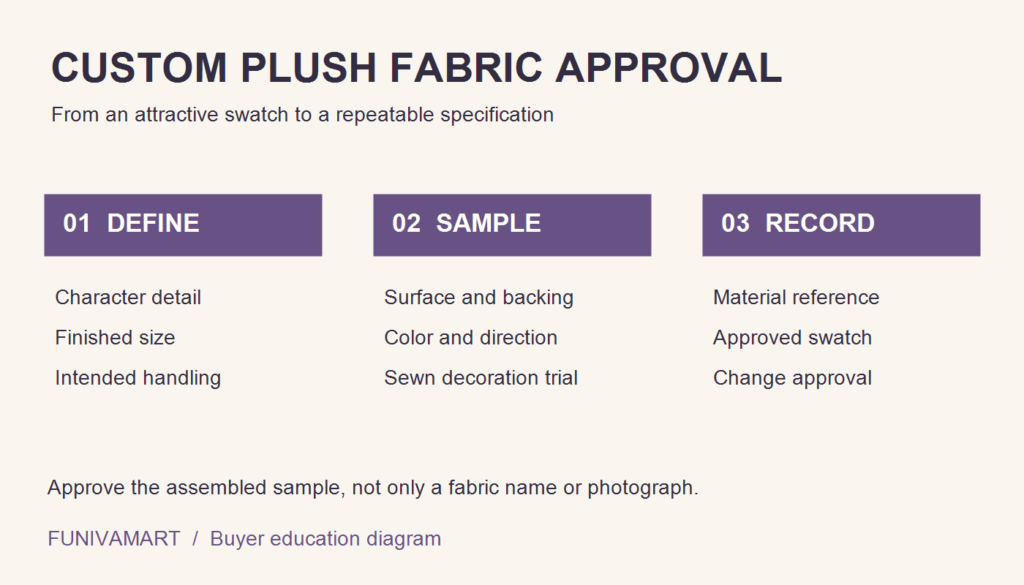
Choosing fabric for a custom plush toy means balancing the character’s appearance with how the finished product will be made, handled and maintained. A fabric that looks attractive as a flat swatch may behave differently around a small muzzle, an embroidered eye or a curved seam. Start with the design and intended use, then compare physical samples before approving a production specification.
This guide focuses on sourcing and sample approval for brands, retailers and character owners. It does not treat a fabric name as a quality grade or a safety certificate. The useful outcome is a written material specification and an approved sample that both buyer and manufacturer can refer to throughout the order.
Begin with the character and intended use
List the features that make the character recognizable: silhouette, face proportions, color blocks, surface texture and any printed or embroidered details. Identify which features must remain visible at the proposed finished size. A long, fluffy surface may suit one character while obscuring the expression of another. The smallest important detail often sets the practical limit for surface texture.
Describe who the product is intended for, where it will be used and how it should be maintained. A display collectible, a frequently handled mascot and a compact bag accessory present different design priorities. Do not assign an age grade or a washing claim from the fabric alone; those decisions depend on the complete finished product and supporting evaluation.
Separate fiber content from fabric construction
Terms such as plush, fleece and velboa describe a broad commercial family or surface appearance, rather than a complete specification. Ask for fiber composition, construction, pile length where applicable, fabric weight, usable width and the supplier’s material reference. Two swatches sold under the same familiar name can feel and perform differently.
The surface and backing also work together. A soft face does not tell you whether the backing stretches, how a seam behaves or whether stitching will show through. Request enough material to examine both sides and make a small sewn trial. Record the exact reference for each candidate so an appealing sample is not replaced later by a vaguely similar material.
Compare short pile, long pile and smooth surfaces
Short-pile plush
A shorter surface is a useful starting point when facial features, small color panels or a clean outline are central to the design. Compare how clearly the actual embroidery and seams appear on each candidate. Short pile is not a guarantee of easy production: density, backing, stretch and finishing still affect the result. Review the assembled sample rather than judging only a close-up photograph.
Long-pile or faux-fur effects
A longer pile can create a fluffy silhouette or emphasize particular areas such as a mane or tail. It also changes the visible outline around facial details and joins. Ask how the pattern will account for the surface and whether seams need additional finishing. Inspect the face from normal viewing distance as well as close up, checking whether the intended expression remains readable.
Fleece, felt-like and other smooth options
Smoother materials can be worth sampling for flat details, clothing or graphic shapes. Their suitability depends on the exact construction and application. Check edges, bends and attachment points on the actual design. Avoid assuming that a material appropriate for a decorative patch will also work as the main stuffed shell, or that every smooth fabric accepts the same printing process.
Check pile direction and stretch on the pattern
Brush a pile fabric in different directions and compare its appearance under the same lighting. Direction can change the perceived shade and texture. Specify the intended orientation on visible panels so neighboring pieces do not look unintentionally mismatched. For a symmetrical face, compare the left and right sides together rather than approving them separately.
Ask the sample maker to show how stretch interacts with the pattern and stuffing. A shape that looks balanced before filling may widen or elongate after assembly. Evaluate the finished dimensions at agreed measurement points and record the filling condition used for comparison. Changing the shell fabric can require pattern adjustments even when the artwork and nominal size stay the same.
Approve color using physical references
Screen images are useful for shortlisting but are a weak final color reference. Lighting, cameras and displays can all affect what a buyer sees. Provide a physical reference or an agreed color system, then review the proposed material under a consistent viewing setup. Compare adjacent colors together, especially pale faces, contrasting ears and embroidered features.
Distinguish a readily available stock shade from a custom-dyed option. Ask what quantity, scheduling and approval steps apply to the proposed route without assuming a universal minimum. Keep a signed or otherwise clearly identified reference swatch and define how shade variation will be reviewed. If different batches are needed, agree how that will be communicated before cutting starts.
Test decoration on the chosen material
Do not approve embroidery or printing only on a substitute fabric. Ask for the actual artwork at its intended size on the shortlisted shell material. Inspect the edges of lettering, narrow lines, small spaces and light areas. For embroidery, examine the reverse side and how the fabric behaves around the stitched area; for printing, review the proposed method and finish.
Surface texture can alter the appearance of fine detail. A face may need a different line thickness, backing arrangement or separate panel to retain its expression. Those are design decisions to approve on a sample, not last-minute assumptions for production. Record the approved artwork version alongside the fabric reference so a later revision does not silently invalidate the earlier trial.
Evaluate handling and care as finished-product questions
Ask what checks are proposed for the product’s expected handling and cleaning conditions. Relevant observations may include surface change, loose fibers, color transfer, seam appearance and shape retention. The appropriate methods and acceptance criteria should be agreed with qualified technical support for the intended product and market; a casual hand test is not evidence of compliance.
Material documentation is useful, but its scope matters. A report for one fabric does not automatically cover a different color, print, trim or assembled toy. Keep material identities linked to the samples and any applicable evaluation records. Avoid adding claims such as hypoallergenic, non-toxic or suitable for all ages without evidence that supports the exact wording and product.
Care instructions should reflect the complete construction, including filling, decorations and attached components. A washable fabric does not by itself establish that the finished plush can be machine washed. Our separate plush fabric care guide addresses maintenance considerations; confirm the final product’s instructions during sample approval.
Understand how material choices affect a quotation
Compare quotations against the same material specification. Unit price alone can conceal differences in fabric reference, usable width, color route, decoration or finishing. Ask which material is included, whether it is currently available and what happens if replenishment is needed. A quoted alternative should be identified and sampled rather than treated as interchangeable by default.
Pattern layout, pile orientation and panel size can affect how efficiently material is used. Ask the manufacturer to explain the practical trade-offs for your design instead of requesting the cheapest fabric in isolation. A small change in panel placement may be more acceptable than changing the character’s main surface. Review those options before approving the production sample.
For broader planning, see the guide to custom plush minimum order quantities. Confirm the actual order conditions in writing for the selected design and material; a general planning article cannot substitute for a project quotation.
Use a simple fabric approval record
Create one record for each material used in the product. Include the supplier reference, composition, color reference, construction, pile direction, intended panel and approved decoration trial. Attach photographs for identification, but retain physical swatches when possible. Date the approval and identify the design revision it belongs to.
- Material identity: exact reference and specification, not only a trade name.
- Visual reference: approved color, texture and orientation.
- Assembly reference: sewn sample, dimensions and decoration version.
- Evaluation scope: agreed checks and applicable supporting records.
- Change control: written approval required before substitution.
Keep a matching reference with the buyer and production team. If a material becomes unavailable, request an alternative swatch and a revised sample where necessary. Document what changed and whether previous checks need to be repeated. This gives both sides a clear basis for accepting or rejecting a substitution.
Frequently asked questions
What is the best fabric for a custom plush toy?
There is no universal choice. Start with the character’s detail, finished size, intended handling and production requirements. Compare a small number of identified materials on sewn samples, then choose against written priorities rather than softness alone.
Can I choose fabric from a photograph?
A photograph can help shortlist an appearance, but it does not establish feel, stretch, backing or reliable color matching. Request physical swatches and an assembled sample before final approval, particularly when texture or facial detail is central to the character.
Does recycled fabric automatically make the toy sustainable?
No single material label establishes the overall environmental impact of a product. Ask for evidence supporting the specific recycled-content claim, its scope and traceability. Consider the complete construction and avoid broad environmental marketing language unsupported by the available documentation.
Can the manufacturer change fabric after sample approval?
Your order specification should define a written approval process for substitutions. Review any proposed replacement for appearance, assembly and relevant evaluation needs. A similar trade name or color description is not enough to establish equivalence to the approved material.
Prepare your material brief
Bring together the character artwork, target dimensions, intended use, color references and a short list of non-negotiable details. Identify where you are open to alternatives. Use our questions to ask a plush toy factory to structure the discussion about samples, specifications and change approval.
For a Funivamart project enquiry, submit your design and request a quote based on clearly identified material options. Ask which details need physical sampling before the quotation and schedule can be finalized. A practical material brief helps turn a visual idea into a reviewable sample and a consistent production reference.