
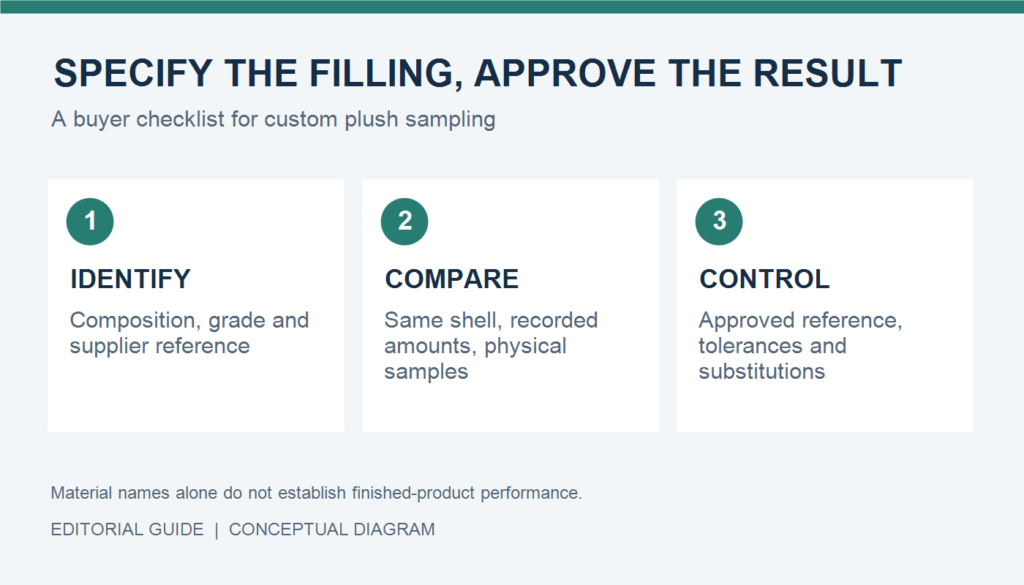
Filling materials for custom plush toys influence the product’s shape, weight, firmness and feel. Choosing them is not simply a matter of asking for the softest stuffing. The same filling can behave differently inside a compact mascot, a long limb or a broad cushion-shaped character. A useful purchasing decision combines an identified material with a controlled sample and a written filling specification.
This guide helps brands and character owners prepare that specification. It separates material identity from finished-product performance and explains what to compare before approving production. Material availability, suitability and order conditions must be confirmed for the individual project; the examples below are options to discuss, not a statement that every option is offered for every Funivamart design.
Start with the desired finished result
Describe how the character should look and feel when someone picks it up. Should the body hold an upright silhouette, drape loosely or compress easily? Which parts need a clear outline? A round face, narrow neck and long ears may require different filling distributions even when they use the same material. Mark those priorities on the artwork before asking for alternatives.
Also specify the intended user, product size, handling conditions and proposed care instructions. Those requirements affect the complete construction, including shell, seams, inner compartments and accessories. Avoid choosing a filling first and assuming the rest of the design will adapt without revision. Review filling and the outer fabric specification together.
Identify the material beyond its trade name
Ask the supplier for the actual composition, material reference and relevant technical information. Commercial labels such as soft fiber, premium stuffing or cotton-like filling do not provide a reproducible specification. Where a quotation uses an abbreviation or translated trade term, ask what polymer or fiber it refers to rather than interpreting the name yourself.
Record whether the material is loose fiber, a shaped insert, a particulate filling or a combination. Ask how it is supplied and whether different grades are available. Keep the approved reference linked to a physical sample and the supplier’s documentation. This makes it easier to recognize a proposed substitution before it becomes part of the order.
Compare the main construction approaches
Loose fiber filling
Loose fiber is an option to evaluate when the design needs a compressible body with filling distributed through several shaped areas. Polyester fiberfill is one example, but a composition name alone does not establish its grade, feel or recovery. Request identified candidates and compare them inside the same shell, with the same filling procedure and clearly recorded amounts.
Check small extremities as well as the main body. Look for empty areas, uneven distribution or obvious lumps, and compare the appearance after normal handling under an agreed review procedure. A sample can feel soft overall while still having an overfilled muzzle or an unsupported neck. Describe each problem by location so a revision is specific.
Shaped inserts and foam-based options
A shaped insert may be considered when a particular outline or internal structure is important. Ask what the insert is made from, how it is cut or formed, and how its edges interact with the shell. Evaluate the assembled result for visible ridges, movement and changes in feel across the product. Do not assume an insert can replace loose filling without adjusting the pattern.
Discuss care and packaging with the proposed insert in place. An acceptable appearance immediately after assembly is only one checkpoint. Ask which observations will be made after the agreed storage or compression conditions, and how the sample will be assessed once unpacked. Use documented conditions rather than a general promise that the material always returns to shape.
Granules or weighted components
Some concepts call for a different weight distribution, for example to influence how a display character sits. Treat any granular or weighted component as a separate engineering decision. Identify its material, amount, location and containment method. Review whether the resulting product is appropriate for the intended users and market before including it in an order specification.
A heavier feel is not evidence of better quality, safety or a therapeutic benefit. Do not add health, calming or sleep-related claims merely because a product contains weight. Ask qualified technical support to assess the complete design, including access to internal components and the behavior of seams and compartments. Avoid describing a conceptual construction as already tested.
Separate filling weight from firmness
Total weight is useful for consistency checks, but it cannot describe the entire feel of a plush toy. Shell volume, fabric stretch, material grade and distribution also affect the result. Two samples with the same total mass may have different head shapes or different firmness in the body. Evaluate weight alongside appearance, dimensions and tactile reference samples.
Request the filling amount separately from the complete product weight where practical. Accessories, internal components and packaging can otherwise obscure a meaningful difference. If the head and body have separate filling targets, record both. Agree a workable tolerance with the manufacturer after sampling rather than inventing a universal percentage for all designs.
Make sample comparisons useful
Change one main variable at a time when possible. If a revised sample changes the fabric, pattern and filling together, it becomes difficult to understand which change improved the result. Label each candidate with its material reference, filling amount, pattern revision and date. Photograph the same front, side and back views using consistent positioning.
Prepare a short comparison sheet covering silhouette, feel, distribution, dimensions and response after the agreed handling procedure. Ask reviewers to describe observations instead of using only words such as nice or premium. For example, noting that the left ear remains visibly empty gives the sample maker a clearer revision target than asking for better stuffing.
Once a candidate is selected, retain a reference sample with the buyer and a matching production reference where feasible. Record any acceptable variation that photographs cannot show. Approval should identify the whole construction, not just the bag of filling used to make it. Keep the reference available during production review and inspection.
Check care, packaging and recovery together
The care claim belongs to the complete product. A supplier’s statement about a filling material does not establish that a toy with that filling can be machine washed or tumble dried. Shell color, decoration, seams and additional components may change the result. Agree the proposed care method and how it will be evaluated before creating consumer instructions.
Packaging should also be represented in the sample review. If the product will be compressed for shipping, discuss the actual method and the expected unpacking process. Ask how shape and feel will be compared after the agreed conditions. Keep this separate from a claim of permanent recovery, which would require suitable evidence for the particular construction.
Use evidence for safety and material claims
Requirements depend on the product, intended age group and destination market. For the United States, the CPSC Toy Safety Business Guidance identifies stuffed and beanbag-type toys as a specific area of the toy standard and describes seam testing. This US reference does not establish compliance for a proposed design or replace assessment of other applicable requirements.
Ask the responsible compliance specialist or testing laboratory to identify the evaluation needed for the actual product. Ensure documents refer to the relevant material and construction, and review whether a change affects their applicability. Do not describe all fillings as non-toxic, hypoallergenic or suitable for every age without evidence supporting the precise claim.
For recycled-content proposals, request documentation that identifies the material, claimed proportion and traceability scope. Keep the wording narrow enough to match the evidence. Recycled content does not by itself prove that the whole toy is recyclable, biodegradable or environmentally preferable in every respect. Confirm the intended consumer wording before artwork and labels are approved.
Build a filling specification for the quotation
- Identity: composition, supplier reference and approved grade.
- Construction: loose filling, insert or combination, with locations identified.
- Quantity: agreed filling amounts, measurement method and tolerances.
- Reference: approved sample, pattern revision and matching shell material.
- Evaluation: agreed handling, care, packaging and applicable technical checks.
- Changes: written approval before substitution or redistribution.
Compare quotations against this same record. Ask whether an alternative price changes the filling material, amount, assembly process or inspection scope. A lower unit price is difficult to evaluate when those assumptions are hidden. Use the broader factory enquiry checklist to clarify who controls samples and approves revisions.
Frequently asked questions
What is the best filling for a custom plush toy?
There is no single best choice for every design. Start with the required shape, feel, intended use and care conditions. Compare identified materials in the actual shell, then approve the complete sample and its written specification.
Does more filling mean better quality?
No. Increasing the amount can change the silhouette and firmness, but those changes may not match the character. Quality means meeting the agreed specification consistently, including distribution and finish, rather than maximizing the amount inside the toy.
Can I approve the filling from photographs?
Photographs can show outline and visible defects, but they cannot establish feel or compression behavior. Use physical samples for those decisions and keep photographs as identification records. Ask for clearly labeled comparisons when several grades are being considered.
Can a filling material be changed after approval?
Define a written change process in the order. Request the replacement specification and a revised sample where needed, then review any effect on appearance, care instructions and technical evidence. A similar commercial name is not proof of equivalence.
Prepare a clear project brief
For a Funivamart enquiry, bring the artwork, intended dimensions, target feel, intended user and packaging plan. Request a quote based on identified filling options and ask which points require physical sampling. Combining these details with an approved reference gives both sides a practical basis for reviewing the finished plush.